Warrior

My back faces the sea as I sit on the shore opposite Warrior Square. Queen Victoria’s statue is hidden behind a deck with an arch shaped like a house. When we visited Hastings two and a half years ago, I took a picture of my partner and my two older children standing under this arch – could this be our new home?

I’m waiting for enough time to elapse to go to my Jobcentre appointment. Universal Credit has cottoned onto the fact that my baby is weanable and I ought to have a job. I agree with them, but who’s going to employ me? I’ve been looking since May, either over- or underqualified, the problem perennial of the elder millennial.

Querying goes as well as can be expected. My latest agent rejection said she was ‘not enough in love’ to take me on. Like a singleton after months of looking for romance, I’m starting to take it personally. Is my book flawed? Well, yes, but is it so flawed as to be unpublishable? I’m told I write well, and people who have read the manuscript enjoy it, but is it memorable? After so many rounds of editing, the through line is infrastructurally locked in – perhaps that is the problem – perhaps the plot is in service to an aim that is too subtle and lacks excitement. Perhaps nobody will ever be as excited about my book as I am. In that case, why bother planning sequels?

Maybe I’ll have better luck with nonfiction, I lie to myself. Maybe someone will hoover up a book proposal and pay me, a perennially unemployed elder millennial, to write it. Maybe. I mean, it’s a possibility, right?

At least I got my house back. I’ll be back in this area later, ferrying my older children to their weekly contact session with their other biological parent. Does Hastings still feel like home? I look back up at the house-shaped arch as my baby cries next to me. If it is, it’s one I’ll have to fight for

Thoughts on Landslide Beach

What does the end of the world look like? Would you know it if you saw it?

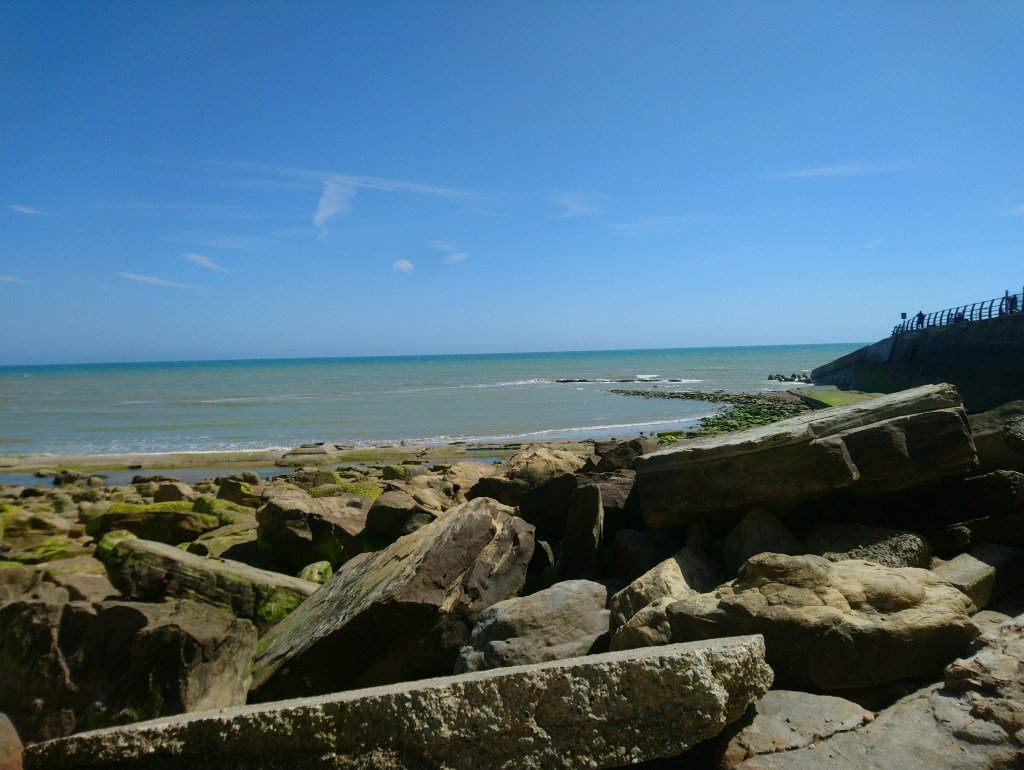
I watch my two older boys play on an area of seaside I’ve taken to calling Landslide Beach. There used to be a promenade, but the cliffs above cascaded it to ruin, and now the only access is to pick your way down boulder by boulder. My baby’s sleeping in the harness; the older boys have scrabbled at the cliff’s edge for around an hour and are now jogging round the sand below, finding big rocks to toss into the sea, whooping at the big splashes. There’s a metaphor there, about a little boy’s desire to make his splash in an impersonal and sometimes hostile sea, but I don’t want to labour it.

A father and his children gouge rocks out of the cliffside, and I think about landslides thundering down, how small and seemingly inconsequential things can start a cascade that can’t be reckoned with or stopped. I want to warn them, these fossil hunters at the edge of the sea, but I can’t.

Instead I listen to the unearthly hum of the wind singing in the bars of the parking lot fence above, and I think about what’s going to happen in the world within ten years, and I look at my boys.

There’s no signal on my phone. When the next Carrington event comes, I think to myself, so many things, including this musing, will be lost.

Seagulls swoop around my older children, and I think about their other parent and how she fed the seagulls on our roof against our wishes and warnings, until the neighbours asked her to stop after we left. I think about the seagull who has staked out our Airbnb window, and I wonder if she has fed it, if she can somehow see us through its beady eyes. There’s a metaphor there about feeding things that harm you, but I don’t want to labour it.

Instead I watch my boys, and I think about the end of the world.

Would I see the landslide before it engulfed me and the people I love? What does the end of the world look like?

What does the beginning of a new world look like? Does it look the same?

Middle

About a week after we moved into the Airbnb, you started complaining about shortness of breath. ‘I think I have asthma,’ you insisted in your small 6-year-old voice – though I’ve never seen you suffer from attacks during your rambunctious play. Mindful that breathing complaints are often related to emotional distress, I began looking for play therapy.

Of my three children, it’s your name I say the most. ‘MIDDLE,’ I shout to your older brother when he’s behaving childishly, before correcting myself. ‘Can you change Middle’s nappy,’ I ask my partner, before he corrects me – I have another baby now.

And of course, I say it a lot to you. ‘Middle, stay close to me in a crowded place. Middle, please mind your baby brother. MIDDLE! Stop jumping between the sofas! This isn’t our flat, you know!’

‘I miss our house, Mummy. When can we go back?’

And I can’t tell you whether or when we’ll be going back. One more of your many questions I can’t answer, Mr Questions. (You hate that nickname.)

Last night I read you a Choose Your Own Adventure book. You tried to land on a black hole and your story ended with one sentence: You are never heard from again. ‘Mummy,’ you said to me, ‘how would you feel if I grew up in space and decided to go to your home planet and landed on a black hole and died?’

‘I’d be devastated, Middle,’ I replied.

‘But you’d probably be happy not to hear my annoying shouting again.’

I looked at you and swallowed down my feelings. ‘No, Middle, I would never be happy. I would be so sad and so devastated that I would do anything to hear your shouting again.’

And I hugged you tightly and held you close, and I told you how much I love you, and I felt you inhale quickly in shallow little gasps.

you told me once
about a woman you met
in a dream.
she came to you
and you asked her
'what do you want?'
and in reply
she unhinged her jaw
gurgled a hiss
and pointed down
the deep darkness
of her throat.

i can't feed her anymore.
she ate you
but she won't eat me.

look at her again--
she is you
newborn as a baby
and all she wants
is for you to cradle her
gently
to your breast
and nurse her back to sleep.

On electricity

Following a brief blackout during Storm Eunice in which I literally couldn’t do anything – even have a hot bath – I have become preoccupied with the idea that Western society has become far too dependent on electricity. We use it for everything, even things which we have been doing electricity-free for thousands of years: cooking, heating, food storage, laundry, cleaning, lighting, communicating…

When the next Carrington event comes, we’re fucked, basically.

Approached from an animist perspective, how does one enter right relation with electricity? A prominent occultist recently described electricity as a ‘permanent scream’, a theft from the Stone People. A gift, for which to be thankful, before acknowledging that our relationship with electricity is fucked.

If electricity, like fire, was thieved from the gods, and if the gods who grant electricity are of the Earth – in the form of conductive metals, wires through which the current travels before it must be ‘grounded’ – then electricity is inherently chthonic. It comes from the Underworld.

(This would then paradoxically set Fire up as an opposing force from the Sky – which is interesting because technically the natural kindle of a lightning bolt is pure electricity! Anyways.)

If electricity is theft, and humans have done the thieving rather than sympathetic Titans, then it is us, rather than Prometheus, who have chained ourselves to a rock. An electric chair. Pre-cooked for interested eagles.

ANYWAYS. What can be done about our dependence on electricity? How can we unchain ourselves from the rock?

(Come to think of it, Electricity is generated by combustion, giving it a reciprocal relationship with Fire. Anyways!!)

So here is my partial list of how to enter into right relation with electricity, bearing in mind that my family is currently wholly dependent on the stuff. I will go through as many uses of electricity in my household as I can think of, and consider any manifest alternatives.

1) Heating / Cooking. I’m combining systems where that makes sense. Heating and cooking are really just one system, because cooking by definition involves heat. Now, you could use electricity to heat filaments in your radiator or hob, or combine it with gas, but were someone to set off an EMP bomb in your neighbourhood you at minimum wouldn’t be able to heat your home, and potentially you wouldn’t be able to cook as well! Unless you built some kind of risky campfire in your back garden, and I don’t know about you but I don’t have any practical cooking cauldrons.

Combustion produces objectionable emissions, but are these emissions really much worse than that required to produce a kWh? Not to mention that we’ve been using fire for cooking and heating for thousands of years, and I think Fire misses our company. When combined with other reductions in electricity use, I think combustion for heating and cooking is an acceptable and sustainable alternative.

2) Food storage. I ask you, do we really require appliances running at all times, just to prevent our food from rotting? For one thing, older homes have pantries or cellars which also double as cool rooms. For another, you can build a zeer pot using just two large terracotta jars, a bag of sand, and some water. If a zeer pot can keep food cool in the Sahara, then we don’t need electricity for refrigeration.

Ah, but what about freezing? What about it. Humans have smoked, salted, and fermented food for thousands of years – your chest freezer is not the be-all end-all of long-term food storage. In fact, fermented food is demonstrably better for you, so why demonise the rotting process when you can use it to such advantage instead? In short, give me back my pantry, I want to stash sauerkraut in it!

3) Laundry and cleaning. This is probably the trickiest one, because the adoption of electricity in these systems was done to relieve housewives of the burden of ‘women’s work’. I, for one, don’t know how to use a mangle, and the harmony of my household relies on a functioning dishwasher. Not to mention that every time I’ve tried washing clothes in a bath they come out smelly, and brushing a carpet is an experience I would rather not repeat.

And yet. We already ditched our tumble dryer as air drying is significantly more economical. With a little research, I could probably get the hang of hand-washing. All we’re missing is a (completely optional) mangle.

Having said all that, is the ‘problem’ with laundry and cleaning that it is time-consuming and wearisome, or is the actual problem that the burden of these tasks still falls almost completely on women? Would laundry and cleaning be so burdensome if women’s work wasn’t routinely devalued?

My proposed solution, therefore, is threefold:

  • Overthrow the patriarchy (ie make men do hand-washing)
  • Rip up your carpets and replace with large, luxuriant rugs that can be transported outdoors and shaken (or just have wooden floors…or use a vacuum, I guess. Humph.)
  • Bring back the laundrette, because then the electricity use is outsourced to someone else with the added benefit that you have an excuse to leave your house and meet people

4) Communication and lighting. Here it is. The one thing I would continue to use electricity for.

Where would we be without the telegraph and lightbulb? Without the ability to speak near instantaneously with loved ones and even strangers across the oceans? Without the ability to see things and not run the risk of setting our whole damn house in fire?

Whether for better or worse, we wouldn’t have computers and the internet without the lightbulb and telegraph. However gross both of these things are, they remain the greatest repositories of human knowledge that have ever been. (Much as I prefer knowledge in more resilient physical or oral form.)

So in my retrofitted house setup, most everything would be analogue except for a quarantined ‘computer room’, and maybe a home lighting system. Food can be preserved and prepared with minimal wastage of the gift from the Underworld. The mechanics of our life above should not rely on theft from Below.

(She says, in a blog post on the internet. Anyways!)

how do you move in dreams?

(inspired by Timothy J Knab’s A War of Witches)

the nahua believe
that everyone has
an animal
in the underworld

born on the same day
at the same time.
they are our eyes
in dreams--

creeping low on the ground
or perched on a tree
they give us eyes to see
in dreams.

so
how do you move
in dreams?

do you stride tail-up
through the brush
or swim in the sea
or fly high above?

i dreamt recently
that i could not drive
from one place to another
because of a great flood

of water blocking my path.
i saw the depths of the water
as i hovered above
watched my car sinking

hovering

later in a room a woman
came to me. she looked
like my mother's relative, and i asked
who she was.

she said she was inside me
she didn't want to answer
she shifted to a young black woman
and back to an ageless white one

and showed me the corner of a mattress
referencing a childhood fear
and i began screaming
i screamed and screamed

and no-one came

and i looked
in the mirror
as i screamed

and saw a woman
the same who appeared
in the dreams of a man i used to love

mouth open
jaw unhinged
with a hissing sucking scream

emanating from the blackness of her
open throat
insatiable need
a trauma you feed
trauma
trauma
trauma

so

how do you move
in dreams?

when i was a child i learnt
how to fly
in dreams.
i knew i was dreaming

because i could jump up
and then hover
swimming through the air
not flying

but swimming
a butterfly stroke
through the air
hovering

fluttering

On death

I started eating chicken again recently, after nearly nine years of abstention. I hesitated on reintroducing chicken for some time, despite reintroducing eggs and fish; but I realised that my relationship with plants has changed, with place, with death has changed, and that I no longer consider the consumption of high-welfare meat such an atrocity, as I once did. So I found a local butcher and roasted a bird.

As all things are ultimately emanations of the Earth, all things have a built-in ‘shelf life’, after which they must return to the Earth. Death is the engine on which life runs – as we get older, our bodies remind us that we’re made of food, and that we are obligated to feed in return. We eat animals, who eat plants, who eat sunlight and soil, and when we die the soil eats us.

I think about this a lot as I use my body to feed my new baby. I think about it when I see social media posts lamenting at the ageing process, or talking about death in a way that fundamentally misunderstands it, as though it were a completely separate phenomenon to life rather than intimately intertwined, optional rather than fundamental.

In my mind’s eye I get a vision of the Saturnine deity sometimes. It dwells under the ground, and the honey-coloured grains grow above, sprouting over It. Their roots hang over the deity’s head, and It braids them together, as It braids us together; our roots intermingle, cross-pollinating, breeding new life, compelled by forces we either cannot or do not wish to see. I like to think that I too will weave life together when I return to the ground, Saturn’s handmaiden.

I’ve worked out that each kilogram of chicken makes one meal for at least four people. After roasting it and pulling off its meat to save, I harvest its bones and make broth in my pressure cooker. Two hours later, the bones are so soft they snap like twigs, and I inter the hen’s remains in my compost – ready to feed new life, to return once again to the Earth.

On indigeneity

This post got delayed for Covid reasons, but better late than never.

Looking around my bedroom, I see lots of man-made things. Everything in here started as an idea – the packet of nappies, its cotton harvested and formed and shaped to mould to a small baby’s bum, wrapped in plastic derived from petrol pumped from the ground; the wardrobe, its wood precision-cut and sanded, smoothed down and assembled. The shelves the same, each heaving with the polished ideas of paper leaves bound together between hard covers. I look around – everything in here, everything I can see, started as an idea in the mind of Man.

Everything, except one thing. I glance at the top of a dresser and see a stone, a large chunk of what looks to be unrefined crystal quartz I found on a beach somewhere, I can’t remember where. It could have been a beach in California, where I holidayed a couple of years ago, or Rhode Island, or the Caribbean, many more years ago. I’ve carried this rock, this sea-washed stone, between several house moves, to the point where I’ve lost track of its originating place, its root. This stone alone, of all the things I can see around me in my bedroom, did not originate in the mind of Man. Instead, it emerged as an idea of the Earth Itself, refined only by the movements and machinations of the sea.

Have we ever been so isolated from the Earth and Its raw manifestations? I look around and see plastic, plastic, plastic. Disposable, yet eternal. The Plastic Age will be picked over in many generations hence, by archaeologists trying to pinpoint the moment of our global collapse.

Or, maybe not. In generations hence, there might not be archaeologists – only tribes, tribes who know better than to pick over a global civilisation’s graveyard, who tell stories instead, songs about what happens when you build too high, robbing the foundations of your house to reach the clouds.

Europeans have an uphill road ahead of them, to relearn indigeneity. We haven’t been properly indigenous since the original sin of the Roman Empire, a glittering fever dream that infected every corner of our continent in the centuries since – followed by the rest of the globe.

I recently read an excellent book by Tyson Yunkaporta, Sand Talk, that accelerated my already-extant thinking and questing for a European indigeneity. Yunkaporta makes the point that even an Indigenous sense of time differs from a Western one: it is cyclical, interlinked with cycles of family and ancestors, with cycles of nature, cycles of culture and civilisation, birth and decay and rebirth. Time and place are linked, such that stories of the past can be entrusted to and held in the land. When your ancestors’ stories are kept by the land you live in, your relationship with the land is by necessity custodial.

When your stories are kept in books you can take to any land, or in 0s and 1s which resolve to words on a screen; when your ancestors stay dead; when time moves in a straight line, from past to present to future; when your relationship with the land also moves in a straight line, demanding growth, growth, growth forever – how can you enter into right relation with time, with place, with people? What incentive is there to take care of the Earth?

Now I sit in my lounge, jumbles of baby plastic and books and polyurethane furniture around me. I see one seashell that’s freed itself of the glue my middle son used to attach it to paper. It is the one thing in this room purely of the Earth. I look out my window at the Victorian terrace opposite – gravel, brick walls, cars. Bushes, upheavals of the Earth, are sparse.

The Roman empire has reached its apex in the American concept of whiteness. Roman citizenship was reserved for elites and conferred rights to own land and vote. Without citizenship, without this permission to help shape Rome, you were merely Rome’s subject, a tally number in a tax record, to be dealt with at the pleasure of empire. Whiteness emerged in America to differentiate citizens from slaves, to elevate settlers above Indigenous. The citizenship of whiteness expanded from just the land-owning English settlers, to other Western European settlers, to any native English speaker with pale skin. This anglophone class of privilege now even extends to pale Australians whose ancestors were exiled East End convicts.

Whiteness sets itself up as the opposite of indigeneity. It is the mechanism through which the land is exploited for growth, ruined, and abandoned, at least in the Western world. (China, the oldest empire, has its own complicated dynamics, on which I don’t feel entitled to comment.) So for Europeans to reclaim indigeneity, they must sacrifice whiteness – and the worldview of empire that it entails.

But how can pale Europeans counter whiteness, and the empire that built it? This is particularly fraught for those of English lineage, in whom can be traced successive waves of settling invaders – Romans, Vikings, Normans – even the Celts were originally settlers on this island. Our prejudice against those with red hair hints at prejudice towards a long-buried indigeneity, a relation to land so broken that the English drove the creation of an empire on which the sun never set.

Indigeneity is a right relation, situating yourself within ongoing cycles of people, time, and land. Indigeneity sees ancestors and their stories in the land, and therefore preserves the land so that the stories can continue to be told. If the stories are disrupted, the land is disrupted and must be made whole.

Europe is a deeply disrupted continent, its cities built tall from the pillagings of empire. But underneath, it’s good land. It holds stories which are crying to be told, animals and blooms desperate to live free. The Earth wants to emanate, to bloom, to hold our stories, because the mind of Man is really the Earth’s Mind, as we are Its children.

So Europeans can start by listening to the Earth, taking care of It, and giving It their ancestral stories. We can also uplift the voices of those Indigenous whose right relation we have disrupted, as well as those who have maintained their right relation even through the privations of empire. In cycles of time, we can help to heal the Earth and all Its children – if we can step back into right relation with our land, and each other.
I’m back!

Oh hey guess what I had a baby! And now my brain fog has finally cleared for long enough to figure out how to get the WordPress app working on my phone, because I won’t be able to sit peaceably in front of my laptop for the next decade. New posts imminent, but not conforming to a fixed schedule anymore because why would I add stress to my life right now.

Wheee!! (…Okay that felt peak-millennial, gross.)